v0.1 · free · runs on your machine

Patent
this repo.

Patty reads your codebase and prepares a US provisional patent application: the specification, the drawings and the cover sheet. You sign and file it yourself. Once it is filed, you can say patent pending.

Claude CodeCursorCodexNo card
patty · first run
›patent this repo
✓patty_startmapped the repo
✓evidence4 mechanisms · 51 citations into the code
✓patty_prior_art4 patent searches · 32 results
✓patty_figures4 drawings
✕patty_checkFAIL · one citation is off by a line
✓patty_checkPASS · 0 errors
✓patty_buildspecification.pdf 8 pages · drawings.pdf 4 sheets
→your turnread · sign · submit · pay
Patty’s first run, on its own repo. Shortened.
6minfirst run, prompt to filing copies
8pages of specification
4sheets of patent drawings
51citations checked against the code
$0for Patty. The USPTO fee is yours.
Why it holds up

Written from your code.
Not from a guess.

An AI draft that guesses is worse than no draft. Patty’s has to point at your source, line by line, or it does not get built.

Every section cites a file and a line.

Your AI tool writes down each mechanism it finds, with the exact lines it came from. Patty opens every one and compares the text.

## E1. Two-stage eviction
Expired entries are removed first.
- src/cache.ts:22 | Expired entries go first
- src/cache.ts:23-29 | if (store.size < MAX) return;

Example of an evidence entry.
A bad packet does not build.

The check fails the packet when:

  • A section has no citation that verifies.
  • The quoted text is not on the cited line.
  • A numeral is in a drawing and not in the text, or the reverse.
  • A placeholder or limiting language is left in.

It draws the figures.

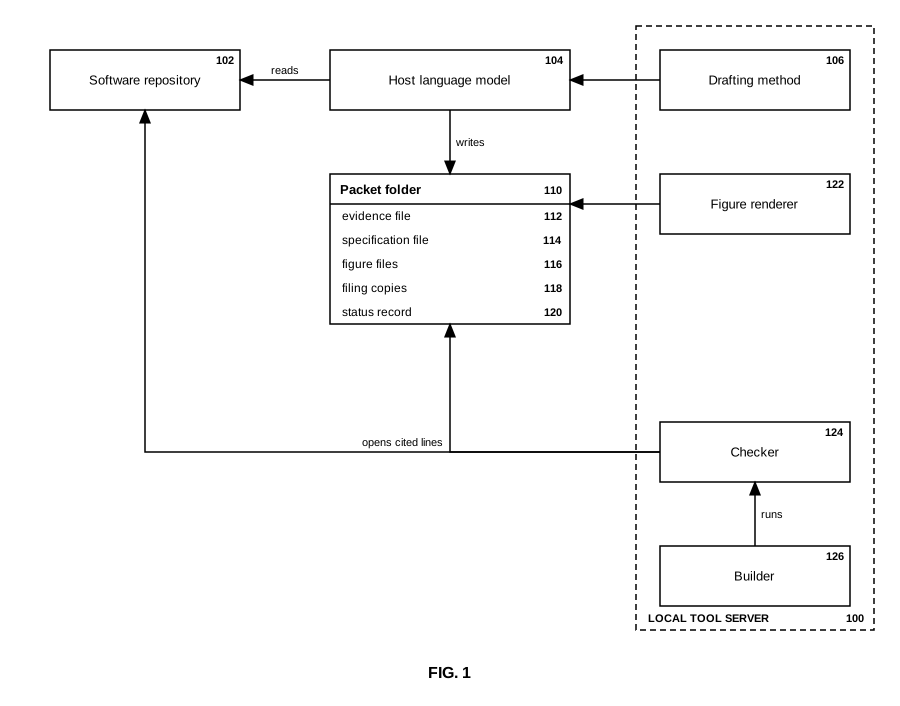
Black on white, numbered, one figure per sheet, the way a patent drawing looks. Every numeral in a drawing has to appear in the text, and the reverse.

Shown: FIG. 1 from Patty’s application for itself.

A patent drawing made by Patty: a block diagram with numbered partsdrawings.pdf · sheet 1 of 4
How it works

Three steps.
One is yours.

01

Say it.

Open your repo in Claude Code, Cursor or Codex and type patent this repo.

02

Patty prepares it.

It maps the code, writes the specification from the evidence, draws the figures, searches patents and runs the check.

03

You file it.

Read it. Then sign, submit and pay in your own USPTO account, with every field and step written out for you.

What you get

One folder.
Everything to file.

Patty writes a packet into your repo. Two PDFs are the filing copies. The rest tells you what to type and when your deadlines are.

specification.pdfFiling copy of the application.
drawings.pdfFiling copy of the drawings.
COVER_SHEET.mdEvery field you will type into the USPTO form.
FILING_STEPS.mdNumbered steps, ending in sign, submit, pay.
DOCKET.mdYour disclosure date, grace limit and twelve-month date.
PRIOR_ART.mdWhat the patent search found, with links.
EVIDENCE.mdEach mechanism, with the file and line it came from.
SPECIFICATION.mdThe editable source of the application.
figures/The drawings as SVG, one figure per file.
First run · November 9, 2026

Patty’s first application
was for Patty.

Patty was pointed at its own repository. Six minutes later it had a provisional application for its own checker. The checker failed the first draft: one citation was off by a single line.

PREPARED BY PATTY · FILING IS THE INVENTOR’S STEP
Where it stops

Patty prepares. You file.

Never signs.

USPTO guidance says a signature is entered personally by the person signing. A tool cannot apply it.

Never submits.

A USPTO account belongs to one person. Patty hands you the numbered steps and every field.

Never pays.

The government fee is yours, paid in your own account. Patty is free and takes no card.

Patty is not a law firm and this is not legal advice. A provisional application is not a patent.

Also

Naming it too?

Patty runs a first knockout check on a name across domains, package registries and Wikipedia, and writes the fields for a US trademark application. It does not search the USPTO register.

Questions

Before you ask.

Is this a real patent?

It is a real patent application. A provisional application is never examined and never becomes a patent on its own. Filed by you, it holds your filing date for twelve months. To pursue a patent you file a full application within that time.

Can I say patent pending?

Yes, once you have filed the application with the USPTO. Not before.

Do I need to be a developer?

You need a codebase and an AI coding tool such as Claude Code, Cursor or Codex. Patty plugs into it, and you ask in plain English.

Does my code leave my machine?

Patty’s server sends no source code anywhere and has no telemetry. A patent search sends your query text to Google Patents. A trademark check sends the name to public registries. The AI tool you run Patty in reads your code under its own terms.

Is Patty a lawyer?

No. Patty is software that prepares documents for you to file yourself. It does not give legal advice. You can take the packet to a patent attorney before you file.

Is the prior art search enough?

No. It is a quick keyword search of patents. It is not a patentability search and it does not cover papers, products or repositories. Finding nothing does not mean an idea is new.

What does it cost?

Patty is free. Government fees are separate, and you pay them yourself in your own USPTO account.

When can I get it?

Version 0.1 runs locally today and is not published yet. Ask for early access and you get the link when the repository is public.

Patent
this repo.

Get early access →

Free. Runs on your machine. No card.